
38.6% of illegal drug users have a drug disorder.
28.9 million or 21.5% of Americans who have consumed alcohol in the past month have an alcohol use disorder.
70.5 million or 24.9% of adults have used illegal drugs or misused prescription drugs within the last year.
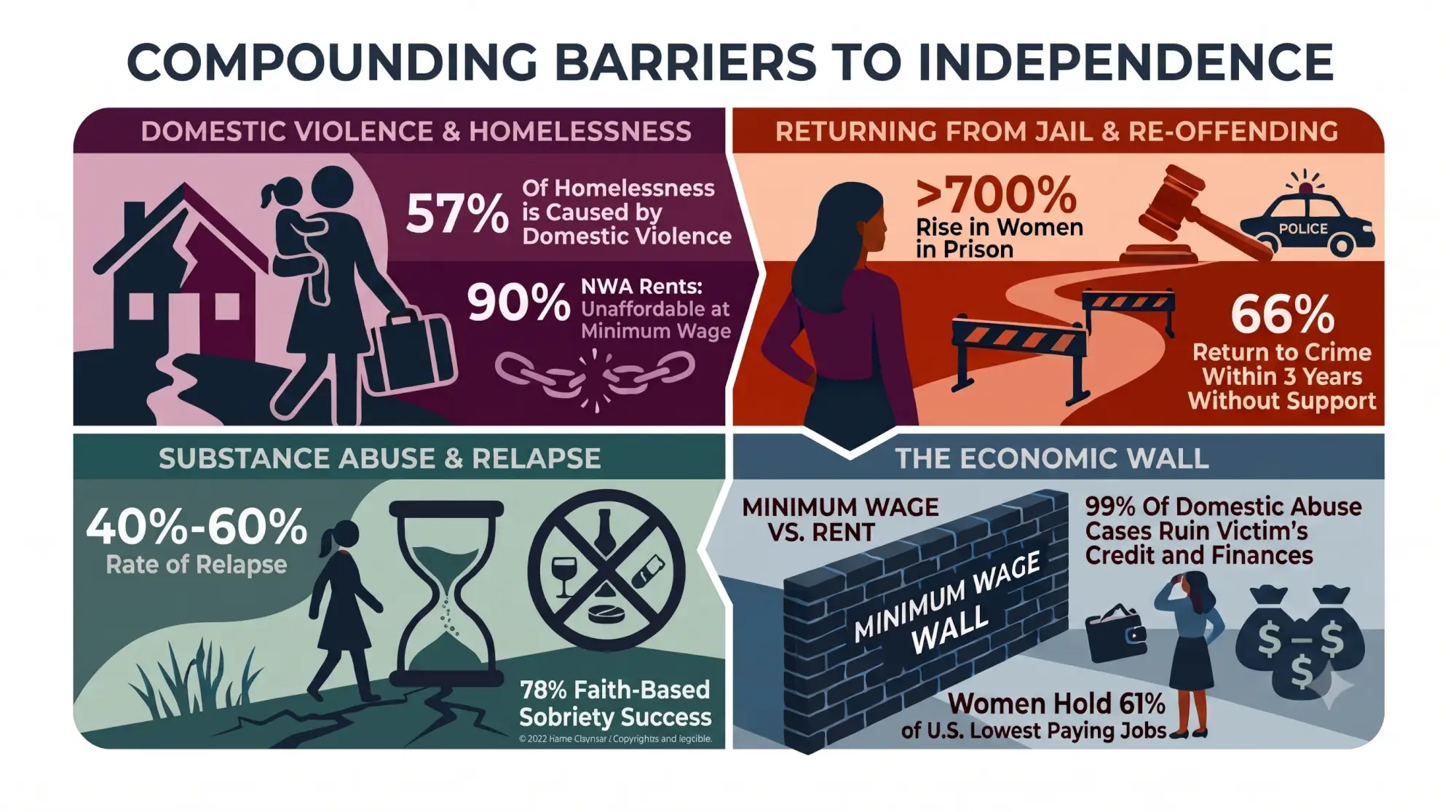
85% of those addicted to drugs revert to drug use within a year after treatment, without support. Discharging individuals directly into unstructured environments during this neurological rebuilding period dramatically spikes failure rates.
Addiction is not just learned, it is taught. Behaviors are often learned early in childhood, and mimicked later in life, creating an ongoing cycle of struggle.
In a 2012 study, almost twice as many people who were unemployed struggled with addiction compared to full time workers.
Statistics show female prison population growth of over 700% since 1980 nationwide. Arkansas is experiencing an acute localized surge. The state's female prison population is projected to grow by an annual average of 2.2% (more than double the 1.0% male projection).
Between 77% and 90% of justice-involved women have survived severe physical, sexual, or emotional abuse prior to their initial arrest.
This statistical saturation establishes the direct "trauma-to-prison pipeline," proving that female incarceration is primarily a mental health and survival crisis. 69% of female felony offenses are non-violent.
In a study in 2005, 68% of individuals released from prison were re-arrested within 3 years.
Average number of requirements that people on probation must comply with per day, or face re-arrest: 12+
There is a 27% unemployment rate among formerly incarcerated people.
49% of individuals with two or more arrests per year have incomes below $10,000.
Compared to a 0.4% male incarceration rate, female lock-ups have increased by 11.9%, an acute localized surge in Arkansas prisons. This is 30X higher compared to national statistics.
The rate of homelessness or housing insecurity among formerly incarcerated people is 5,700 per 100,000.
Data compiled by the National Low Income Housing Coalition's
"Out of Reach" report establishes that affordable rent for a standard minimum wage worker in the state of Arkansas is mathematically capped between $572 and $619 per month.
In the high-growth NWA metro, market-rate rents far exceed this threshold, rendering independent standard leases an economic impossibility without transitional bridges.
This rapid population influx severely compresses the availability of low-cost independent housing options, and pushes previously affordable areas into non-affordable options.
38% of single mothers face housing instability. In NWA, due the lack of low-income units, only 30% of single mothers can be served.
More than 80% of single-parent households are led by single mothers.
The average income a single mother has to meet their financial needs is $40,000 or less. More than 28% of single mothers live below the national poverty line.
Nationally, one-third of women experience severe domestic or intimate partner abuse within their lifetimes.
Locally, 40.8% of Arkansas women experience physical or sexual violence at the hands of a partner.
Arkansas is rated 3rd in the nation for highest rates of women murdered by men.